Programme: Shakti
Katakhali Empowerment and Youth Association
Campaign for Community Based Rehabilitation For the Survivors of Trafficking
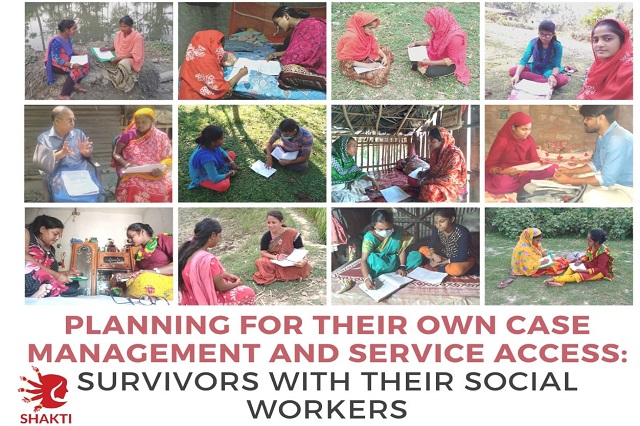
Through this project the social workers have been able to transcend the knowledge and skills to the survivor. This includes being more aware and sensitized about the schemes and entitlement, knowing how to access and avail the schemes and entitlement, applying for the same escalating and following up for the same and how to work with the systems.
The survivors have also been aware and sensitized about different schemes and entitlements, they have developed the capacity and skills of accessing and availing the schemes and also escalating and following it up.
When the survivors adopted these skills within them, they were able to take it back to the community. Therefore, one of the key learning of this project is survivor are able to take up community issues (e.g. domestic violence or child marriage) address these issues and even solve them. As a result, their self-respect, confidence and self-worth has increased in front of the community. They are no longer stigmatized as before by the community. Slowly the traditional rigid mentality of the communities towards them is also changing.
Shakti project has helped the social workers to initiate a process of Stigma counselling, this process led to stigma mitigation. The stigma counselling has been done at the family as well as the community level. The social workers have also made use of influential people viz Pradhan, school teachers etc. for stigma mitigations.
This is a learning mapping process for the social workers, helping them to mirror their work and help them to review their limitations, their flow of work and initiate an ability to strengthen themselves.
Crisis response team is made of few social workers with skill variations from different CBOs. When a crisis comes, this team comes together to respond to the crisis and take up responsibilities to mitigate it.
The Legal case management was further strengthened due to the Shakti project as the project helped in addressing the basic needs of the survivors and minimized their help to the survivors to sustain and continue their struggle for the legal case which is sometimes a very lengthy process. The leadership skill that they obtained from the project also helped them to negotiate and voice their opinion in front of the legal system.
Major Components of Shakti Project
- Survivor’s Leadership: To encourage and strengthen leadership among the women for accelerating rehabilitation support.
- Use of Technology-based MIS System: To strengthen the existing technology enabled Information Hub for easier access to MIS.
- Sharing CBR model with other Districts two districts/organizations of West Bengal will adopt CBR practice.
- Rights Based Case Management: To capacitate the Survivors of Trafficking on their Rights & Entitlements and means to access the same.
- Livelihood and Economic Empowerment: To ensure community based rehabilitation support for vulnerable women and adolescents girls including trafficked survivors with direct involvement of the Self Help Groups.
Community Based Rehabilitation Process
- For economic empowerment the initiation of survivor based SHGs by the CBOs was itself a great move .The process involved motivating the BDO and WTO to accept and appreciate survivor based economic group and also to facilitate the process of giving loans to these groups.
- There has also been a process of modelling a survivor based SHG group with only 5 members, this model was also advocated and showcased and duplicated in other districts.
- Continuous rapport building with BDO, WDO,BLDO for livelihood and the ability to convince and sensitize the duty berates of their demands helped them to avail many schemes which includes livestock schemes.
- SHG with group business and business plan was also initiated initially. They were only interested in individual business, but the CBOS has given them training on the success of group business, made them understand the group capital, also the advantage of collectivism and collectiveness ownership and collective responsibilities, sharing of skills and division of work. Through such a process the survivor learnt the skill of group planning and team building.
- Livelihood and economic empowerment has led to financial inclusion for the survivors , they are now able to contribute at the family level , this has strengthened their decision making position at the family.
Leadership Promotion
- The process of survivors leadership was mostly through hand holding and rapport building with the survivor, creating a safe space between the survivor and the social workers, awareness generation of their rights and entitlement, continuous follow up, talking with the about the trauma, identification of the trauma and addressing it , counselling the family and the community to show respect to survivor and stop stigmatizing them.
- In the process of being leaders the survivors were given several training for their capacity building, they were also handhold by the social workers to go to the different duty bearers to access and avail their rights, to generate demand by using different advocacy and campaigns.
- When they started achieving their demand, the survivors started working for the community, solving community issues, they started doing community surveys, community level meetings and also talking with the duty bearers for solving community issues (e.g. domestic violence or child protection issues). When they were successful in doing such it, they gained more acceptance and respect at the community level. The survivors are also now in many decision making bodies at both local, regional and national level.
- For collectivization the survivors have also formed economic groups like SHGS and also issue based groups like Bijoyini.
Mental Health Management
Mental health was taken as a key aspect of the Shakti programme, the CBOs did a lot of advocacies for integrating mental health for the survivors and also for the community and also for the social workers. There was a series of awareness given to the survivors for the need to access mental health. The service is still not available at all the blocks, psychiatrists are not available at the block hospital. Psychologists are available over phone for free online counselling. This needs to be continued in future, as the pandemic has further enhanced the cases of mental health. Shakti team has learnt that in spite of multiple advocacies there is rigidity in govt. system in regard to mental health services. Mental health is the primary right for all the survivors still the government is indifferent. In the coming phase Shakti team is predicting if deputation at district and state level can help.
Coordination and Management
Mental health was taken as a key aspect of the Shakti programme, the CBOs did a lot of advocacies for integrating mental health for the survivors and also for the community and also for the social workers. There was a series of awareness given to the survivors for the need to access mental health. The service is still not available at all the blocks, psychiatrists are not available at the block hospital. Psychologists are available over phone for free online counselling. This needs to be continued in future, as the pandemic has further enhanced the cases of mental health. Shakti team has learnt that in spite of multiple advocacies there is rigidity in govt. system in regard to mental health services. Mental health is the primary right for all the survivors still the government is indifferent. In the coming phase Shakti team is predicting if deputation at district and state level can help.
Coordination and Management
One of the key lessons of the Shakti Project is formation of several committees like SHG management committees. The Shakti project covers several axes which are also interlinked with each other and having wide coverage, the management /coordination team felt that it was not possible to discuss all issues, challenges and escalate them in one committee nor can it be solved by a single stakeholder. The CBOS leaders of the Shakti project felt that there is a need to have multiple representations of various stakeholder viz directors, social workers and even survivor leaders in different committees. This was mainly done to mitigate issues, solve challenges and escalate and do advocacy. These committees helped in bridging the gap, for better connectivity and very smooth flow of communication and information from the CBO to the field and backward. The committees also helped in monitoring and evidence-based reporting from the community to the CBOs.
When the survivors are rescued, they are kept at these state-run institutions for rehabilitation for almost two years. They receive counseling, free medical aid, and training on livelihood. But when they come back after two years and start staying back in their own community, they face the severe stigma and depression and go back to the same state as when they were rescued. Even the skills or the livelihood training that they usually receive from these rehabilitation institutes are of no use or relevant for them as these training are mostly not demand or market-specific, so both socially and economically the survivor is not at all in a process of empowerment. The survivor’s source of Rights violation is the place where she lives in her community, her Panchayat, Block and thus ensuring her rights and entitlement including rehabilitation process starts at the source level.
Statistics of Project Intervention
- Total Cases: 32
- FIR / GDE Lodged – 21
- Case Hearing Started – 9
- Free Legal Aid Received – 11
- Appealed for Victim Compensation – 10
- Received Victim Compensation – 4
- Livelihood Training Received – 2
- Started Own Business – 6
- Continuing Studies – 4